
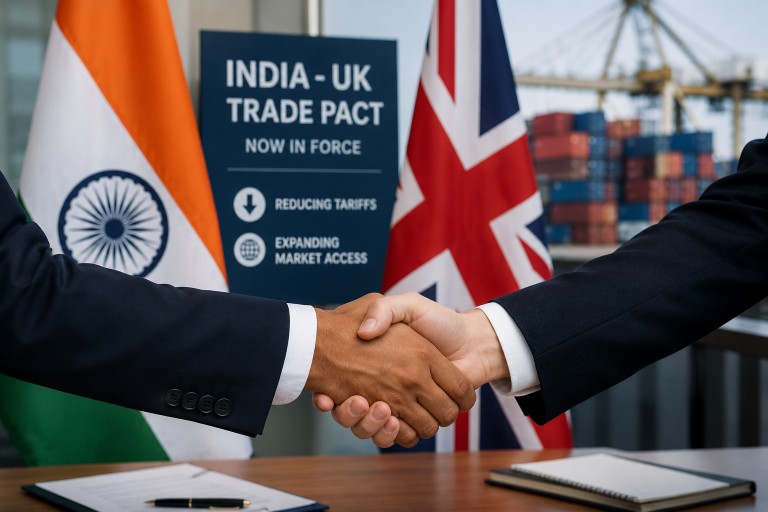
The Comprehensive Economic and Trade Agreement between India and the United Kingdom commenced on Wednesday, ushering in reduced tariffs for a wide range of products and expanding business and professional opportunities across both nations. This agreement allows Indian exporters to enjoy duty-free access to a majority of British tariff lines, which is set to benefit key sectors such as textiles, leather, footwear, marine products, gems and jewellery, as well as processed foods. Indian officials are optimistic about the potential for increased exports by enhancing competitiveness in markets where British tariffs were previously between 4% and 20%.
On the other hand, the UK stands to gain enhanced access to India’s burgeoning economy with phased tariff reductions and quotas in sectors like automobiles and silver. The deal also broadens the scope in procurement, financial services, insurance, education, and professional services. Under this agreement, Britain has committed to immediately abolishing duties on 96.8% of its tariff lines, which covers 97.7% of trade by value. India, in turn, will eliminate tariffs on 64.1% of tariff lines immediately, with a gradual phase-out on an additional 21%, while safeguarding sensitive sectors.
The trade relationship between the two countries has seen consistent growth in recent years. During the 2025-26 fiscal year, India exported goods valued at $13.44 billion to Britain and imported goods worth $11.68 billion. Bilateral services trade reached $35.44 billion in 2024, with India holding a services surplus of approximately $7.9 billion. The engineering sector in India is anticipated to be a significant beneficiary of the agreement, with exports of engineering goods to Britain amounting to $4.7 billion in 2025-26 and expectations to surpass $7.5 billion by the 2029-30 fiscal year.
Covering 137 sub-sectors, the services aspect of the agreement includes areas such as information technology, telecommunications, finance, business services, and education. The deal also eases temporary entry regulations for business travelers, investors, and professionals. Additionally, the Double Contribution Convention that accompanies the agreement exempts qualifying Indian professionals and employers from contributing to the UK’s National Insurance system for up to five years, benefiting about 75,000 workers and 900 employers.
Furthermore, the agreement unlocks government procurement opportunities in both countries. Indian companies will gain access to procurement contracts in Britain, while British businesses will see reciprocal opportunities in India. This mutual opening of markets is expected to create new avenues for collaboration and economic growth between the two nations.