
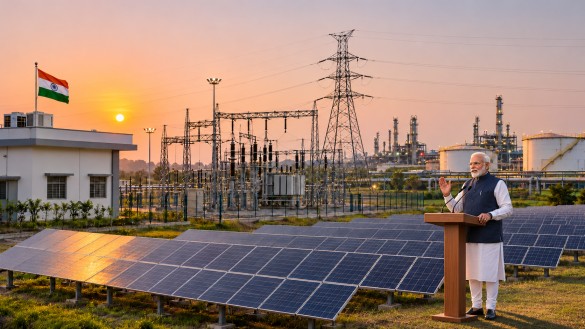
India’s strategic investments in energy security over the past decade have bolstered its resilience against disruptions from ongoing conflicts in West Asia, according to Prime Minister Narendra Modi. Speaking at the Indian Institute of Management Bangalore, Modi emphasized the country’s efforts to ramp up domestic fuel production, build crude oil storage facilities, and expand renewable energy sources including solar, wind, and hydropower.
During his visit to Karnataka, the Prime Minister inaugurated infrastructure projects worth more than ₹15,600 crore, including a new section of the Bengaluru Metro, extending the network’s operational length beyond 100 kilometers. He also laid the foundation stone for several projects aimed at enhancing fuel storage and distribution as well as waste management.
Among the key initiatives highlighted by Modi was a new LPG facility in Mangaluru, which will boost India’s storage capacity by 80,000 metric tonnes. Additionally, the Devangonthi marketing terminal is set to improve the supply chain for petrol, diesel, and aviation fuel. A compressed biogas plant in Bengaluru is anticipated to produce approximately 13 tonnes of biogas daily, reducing waste and reliance on imported natural gas.
Modi noted that India’s renewable energy capacity has surpassed 300 gigawatts. He also pointed to the expansion of rooftop solar installations under the PM Surya Ghar Muft Bijli Yojana and the deployment of solar-powered irrigation pumps through the PM-KUSUM scheme as important steps in the country’s energy strategy.
Furthermore, Modi described India’s growing middle class as a significant driver of economic development, contributing to demand in sectors such as automobiles, electronics, tourism, education, and healthcare. He also underscored India’s advancements in space technology and scientific research, highlighting the practical applications of satellite technology for weather warnings, railway monitoring, and crop insurance assessments.
In Mysuru, Modi discussed the opening of the space sector to private companies and startups, which has fostered new opportunities for innovation and strengthened India’s technological capabilities. His remarks come amid India’s continued focus on building a self-reliant and robust energy infrastructure to withstand global uncertainties.